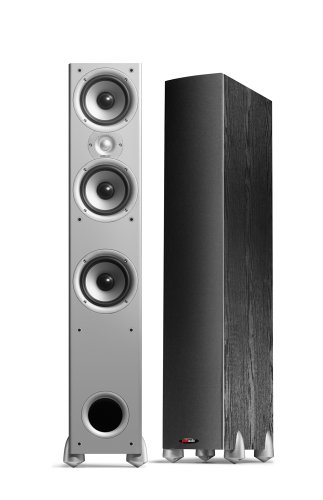
 Buy Polk Audio Monitor 60 AM6025-A 2-Way Floorstanding Speaker (Single, Black)
Polk Audio Monitor 60 AM6025-A 2-Way Floorstanding Speaker (Single, Black) Product Description:
- Single 3-way floorstanding speaker that delivers high performance at a reasonable price
- Equipped with three 5.25-inch bi-laminate composite dynamic-balance drivers
- Equipped with one 1-inch silk polymer-composite dynamic-balance dome tweeter
- All MDF construction with 0.75-inch-thick baffles and extensive cabinet bracing ensure resonance-free enclosures
- Magnetic shielding allows safe placement next to TVs and video monitors
Product Description
The name Monitor is special to Polk Audio. The original Polk Audio Monitor Series, produced in the mid-1970s, ushered in the modern loudspeaker era by setting the standard for performance and value. The original Monitor Series is the line that made Polk Audio famous with its simple, sturdy construction, clear, accurate sound, powerful bass and superior imaging all at a price that made great sound available to everyone. The newly reborn Monitor Series is classic Polk: a quality-built, affordable line of high performance loudspeakers for music and home theater. They are highly efficient, so they can be driven easily by unpretentious receivers, and they are voice matched for lifelike surround sound environments. The Monitor Series boasts a stylish look that complements today’s flat screen technology, with wood grain finishes and modern Titanium faces, and beefy stabilizer feet on the tower models. Built for speed, sound quality and value, the Monitor Series is a great introduction to high performance sound.
Customer Reviews
Most helpful customer reviews
59 of 60 people found the following review helpful. Wonderful Sound, Excellent Value
By Psymon JC
I purchased my Polk Audio Monitor 60s after auditioning "higher end" (read alot more expensive) floorstanding speaker offerings from KEF iQ series, Klipsch RF and F series, and similarly priced speakers from Wharfedale, the Boston Acoustics Horizon floorstanding speaker, and also Polk Audio's own Monitor 50 and Monitor 70.To my ears, the Monitor 60s combine the best elements from all of these speakers. They have a wonderfully open, spacious and detailed sound that results in realistic reproduction of instruments, voices and soundstage. I was bothered by the brightness of the KEFs and Boston Acoustics speakers though these speakers may have had slightly better soundstaging capability. I didn't like the sound of the treble from the Klipschs (specifically their tone and their detail/resolution capabilities), though they had better bass extension and great dynamics (slam). I found the Monitor 50's sound too lightweight, and I was surprised that I didn't like the tonal balance of the Monitor 70s - they sounded too dark to my ears.As other reviewers have noted, the bass is a little too light for home theater use (i.e. to really create floor shaking explosions) but adding a subwoofer (I already had two) removes that problem. On their own, without a subwoofer, I find the bass more than enough for critical music listening. Your mileage may vary, but I have never liked the sound of any subwoofer for music listening (it's too boomy), and the Monitor 60's tonal balance sounds just right for everything from rock, classical, jazz, latin, electro. The bass is very fast and tight and extends deep enough to reproduce nearly all instruments, except deep organ notes and some electronic bass.So I'm very very happy with the Monitor 60s particularly at their low price!
60 of 63 people found the following review helpful. Great General-Purpose Bargain Speaker
By Under the Influence
Here stands the narrow, but deep and tall Monitor 60 (M60), the middle performer of the Polk Audio Monitor series, between the lesser endowed 50 and bigger sibling 70. It's dimensions and tower design make it well suited for home theatre and two-channel music listening. At a height of 37.5 inches it pairs well with TV's perched on cabinet or wall mount. No need for cement bricks or adjustable stands, the 60 will put the seated listener's ear and the center channel speaker on the same plane. The upper three drivers, placed at the top end of the speaker's cabinet, will reach over even the most prominent sofa arms. The cabinet feet are of a hard plastic, spike design that works well enough for carpet or hard surface flooring.The Monitors sound quality is fairly clear and detailed, a slight bit on the bright side, but fairly neutral. I'm certain no one would accuse the Monitor of possessing too much warmth. To answer the million-dollar question - does the Monitor 60 have sufficient bass using a small woofer? My answer is the safe one, drawing up specs (depth versus output), considering intended use (music, movie, listening environment), and understanding human differences, it depends.The M60's frequency response ranges from 38Hz to 25kHz. For those unaware - the human range of hearing is generally recognized to be 20Hz (bass) - 20kHz (treble). Therefore, the 60's bass output leaves room for improvement in terms of depth. However, it's rare for music to reach below 40Hz and for movie watching with deep Low Frequency Effects (LFE) a subwoofer is the ideal choice.Out of the box, prior to break-in, and with no Receiver/EQ adjustment, my preference found the bass lacking prominence when playing a wide variety of music selections. Using the Receiver's "Direct" minimal circuitry setting the M60 produced just enough bass to be adequate for my taste. In fact, at this point, increasing the volume to feel the bass, you'll probably notice the pain in your ears far sooner. However, after about a month of break-in and adjusting the Receiver's EQ, the bass is sufficient. Increasing the bass tone control on the A/V receiver may be enough for some. Most modern A/V Receivers include graphic equalizers for each speaker as well. If the only intended use is music listening, the Monitor 70 with its added depth and three way design is probably worthy of the extra cost, just as the M60 is a better choice than the M50.When considering theatre use and for those who want the deepest, most prominent bass in their music, purchasing a powered subwoofer is the obvious. Similarly priced subwoofers drop down in the upper 20's and mid 30Hz area, thereby filling in the need for any added depth. The Monitor 70 rivals the RANGE of a subwoofer with low frequency output at about 30Hz and seems to be a good choice. However, bass VOLUME superiority from the subwoofer is far more than marginal. The difference is most noticeable on paper when reading SPL measures, but easily identified by even the ears of novice listeners. A tower speaker's added output during movie effects is noteworthy as opposed to the subwoofer which is proud and loud. If you're listening environment precludes heavy bass output, then a pair of Monitor 60 without subwoofer is an excellent choice.My Polk speaker system consists of the Monitor 60's in Front, Polk Audio Monitor Series CS1 Center Channel Speaker (Single, Black), and Polk Audio Monitor 30 2-Way Bookshelf Speakers (Pair, Black) in surround and rear positions. The subwoofer is a 250 watt amped, 12 inch HSU Research to which all bass is crossed-over at 80Hz by the Receiver, a 95 Watt per channel 7.2 surround Yamaha with High Definition audio decoders. Content is provided by a Samsung Blu-ray player and HP Home Theatre PC storing music in .WAVE and .WMA-lossless format. I listen to a wide variety of music, mostly Jazz and Classical, some pop/rock, occasionally techno/industrial, blues, world styles, such as Irish Trad. The 60's seem at home with each genre. However, primarily my system is used for DVD/Blu-ray playback.For added perspective, I listened to music with the M60's connected to a 100wpc Carver Integrated amp and matching CD player in a smaller, less lively room than that where my Home Theatre resides. The room seemed to lend a little upper bass forwardness, but the overall neutral-bright sound was pretty consistent. In addition, I bi-amped the speakers using a 200wpc Adcom 2-channel amp powering the three 5.25 inch drivers and the forementioned Yamaha powering the tweeters. There was no recognizable improvement. I believe that the post processing bi-amp configuration in the Receiver diminishes any potential gain. However, since this is advertised as an efficient 8-ohm speaker with a two-way design, high current configurations probably add minimal improvement in audio quality.Last, Polk speaker quality is well-known in audio circles and the Monitors are no exception. Binding posts, rubber driver surrounds, bi-amping, and solid MDF/wood cabinetry are just some of the obvious signs. It was my ownership of Polk products in the past and their great reputation that had me looking at them in the first place. I must make a confession. Purchasing seven new Polk Monitors for just over $500, with no shipping charges, was a very big factor in choosing this setup. Initially intending to upgrade the Monitors after a year, I'm finding little motivation after a COUPLE of years use, and very happy with the bang for buck performance. After visiting several stores and listening to various setups, it's my honest belief that a noticeably improved upgrade would cost around $1,000 for the pair.
21 of 21 people found the following review helpful.Wonderful Sound, Excellent Value
By Psymon JC
I purchased my Polk Audio Monitor 60s after auditioning "higher end" (read alot more expensive) floorstanding speaker offerings from KEF iQ series, Klipsch RF and F series, and similarly priced speakers from Wharfedale, the Boston Acoustics Horizon floorstanding speaker, and also Polk Audio's own Monitor 50 and Monitor 70.To my ears, the Monitor 60s combine the best elements from all of these speakers. They have a wonderfully open, spacious and detailed sound that results in realistic reproduction of instruments, voices and soundstage. I was bothered by the brightness of the KEFs and Boston Acoustics speakers though these speakers may have had slightly better soundstaging capability. I didn't like the sound of the treble from the Klipschs (specifically their tone and their detail/resolution capabilities), though they had better bass extension and great dynamics (slam). I found the Monitor 50's sound too lightweight, and I was surprised that I didn't like the tonal balance of the Monitor 70s - they sounded too dark to my ears.As other reviewers have noted, the bass is a little too light for home theater use (i.e. to really create floor shaking explosions) but adding a subwoofer (I already had two) removes that problem. On their own, without a subwoofer, I find the bass more than enough for critical music listening. Your mileage may vary, but I have never liked the sound of any subwoofer for music listening (it's too boomy), and the Monitor 60's tonal balance sounds just right for everything from rock, classical, jazz, latin, electro. The bass is very fast and tight and extends deep enough to reproduce nearly all instruments, except deep organ notes and some electronic bass.So I'm very very happy with the Monitor 60s particularly at their low price!
Latest Price: See on Amazon.com!
More Info: See on Amazon.com!
See Customers Review: See on Amazon.com!
