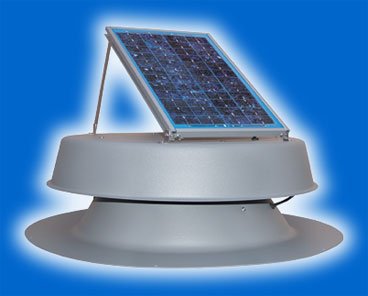
 Buy Solar Attic Fan with 25-year Warranty!
Solar Attic Fan with 25-year Warranty! Product Description:
- No wiring necessary
- 25-year warranty on solar panel
- 25-year warranty on attic fan housing
- 25-year warranty on solar attic fan motor
- Adjustable 10-watt Solar panel - Assembled and Ready to install
Product Description
Solar Attic Fans are easily installed and a great product for proper attic ventilation. Natural Light brand solar attic fans are top rated by builders and are the highest quality built in the USA! The DC motor is powered by the included solar panel with the attic fan motor moving hot air and moisture out of the attic space everyday. Solar panel is adjustable from flat up to 45 degree angle or can be detached and mounted remotely for best sun exposure. Solar Attic Fans mount on 3/12 to 12/12 pitch roofs. (this unit not for flat roofs or side wall mounting). Moves up to 850 cubic feet per minute. Use one attic ventilation fan for every 1200 square feet of attic space. Note: Purchase the optional Solar Attic Fan Thermostat if to be used in areas with cold winter temperatures. See our Amazon Storefront for this optional part.
Customer Reviews
Most helpful customer reviews
338 of 340 people found the following review helpful. Natural Light Systems Solar Attic Fan Review
By Mike Hall
After quite a bit of research, I felt that the Natural Light Systems Solar Attic Fan offered the best combination of engineering, quality, and value compared to competitors. As for performance, I conducted a simple test that is reported below, but am not equipped to compare other brands under the similar conditions. Unfortunately, I couldn't find unbiased brand comparisons.The product sold here is a 10 watt panel unit manufactured in Phoenix, Arizona by Natural Light Systems ([...]). The company also makes a 20 watt panel that costs about $75 more that will probably prove more satisfactory over the long run. The only difference between the 10 and 20 watt units is the panel.BACKGROUNDI have a house with a moderate pitch (I believe about 15 degrees or so), with a black asphalt shingle roof, located in Mountain View, California. When re-roofing the house a few years ago, the contractor recommended installing several small "eyebrow" vents opposite each other along the ridges. They take advantage of the Venturi effect to exhaust hot air. They really weren't sufficient, though. Wind turbine ventilators were too small to retrofit and obtrusive, and over the years I've 1) installed (and removed) a gable fan (noisy and inefficient), and 2) finally re-engineered a large Vornado fan to direct exhause out of a leeward vent. But it was still a bit noisy and used electricity, of course.Hence, the search for a low-profile solar attic fan, though, I did consider a new passive system from Aura (see [...]). That company also has a solar panel version, though there are some features I don't particularly care for. I installed the solar attic fan on the leeward side of the house, facing due south, in place of an eyebrow vent, in the center of the house. I sealed up the opposite windward eyebrow. There are sufficient air intake vents (or soffits). Total attic volume is somewhere between 1,500 and 2,500 cubic feet.PROSSimple and straightforward engineering. This unit comes with a single well-designed fan. One brand that I nearly bought, from Aura, is cluttered with several little fans tucked inside the unit.One piece heavy gauge stamped aluminum body with no seams. The seamless body is leak-proof with no additional caulking needed.Aluminum and stainless steel hardware, so corrosion shouldn't be a problem.High quality BP solar panel (the 20 watt panel, which I have, appears to be the BP-SX320). I understand that most panels degrade in performance over time, so think it's better to start out with a more powerful panel. The solar panel is adjustable - great if you can easily get on the roof and want to pick up the rays from the low spring or fall sun. Out of the box, the solar panel rests flat against the top of the unit; the picture shows it in a raised position.High quality fan motor and blade; easily replaceable if needed. Extremely quiet - I can't detect any noise from the unit inside of the house, and just a slight whooshing a couple of feet away outside on the roof.Twenty-five year warranty, thought it's only as good as the company stays in business. I called customer support and found them friendly and knowledgeable. I think the only parts that could potentially need replacing are the fan motor and panel.Low profile and neutral color helps it blend with many roofing materials and not stick out like a sore thumb.CONSInstallation is, like, all such roof hardware, a little involved for an average homeowner like me. Just take it easy and, as they say, "measure twice and cut once."The company provides a silicone sealant, which I regret having used since there are stainless screws holding the unit down. Probably needed for regions where winds get fierce, but I don't think for my area. The silicone gummed up the wires for the thermostat, though didn't do any harm (fortunately, I could clean them off after installation because I have access to the attic).The solar panel is a bit tough to adjust. I would have appreciated wing nuts rather than Philips screw heads that could easily get stripped.CONSIDERATIONSI recommend getting the thermostat, which is a $20 optional item.Mount on a southern exposure, where there is sun all day (or at least from 10 am or 11 am onwards). In shade, the fan, which is continuously variable speed, will not operate. I believe it will operate, though at a low speed, on a cloudy day. Essentially, the more sunlight, the faster the fan will rotate, hence exhaust more attic air.I recommend the 20 watt panel over the 10 watt panel.You will need to cut a 19" or 16" round hole in the roof (depending on your rafter spacing). 19" is actually fairly large (and what I cut) and will vent a lot of attic air.Solar panels get dusty which can affect their performance; and birds do perch on them, so direct a little garden hose spray up to them occasionally if it doesn't rain a lot in your area.DOES IT REALLY DO THE JOB?I thought I'd conduct a simple test to find out how the unit performed in "passive" state (sans fan) and "active" state (with fan operating).The set-up: I had one remote digital thermometer in the attic about 8-10 feet away from any vents and midway between the floor and ceiling of the attic, about 20 inches off the floor of the attic. Another thermostat was placed in a shady spot on the patio away from the house.The test: I chose two comparable sunny, mild days (75 to 76 degrees F. on May 27 and 28, 2009) with a breeze out of the northwest at about 5 mph. On the first day, I covered up the solar panel, so the vent became passive. On the second, the panel was uncovered and the vent was active. I took measurements roughly every hour from noon to 6 pm. I found the patio temperatures peaked on both days at around 76 degrees from 3 pm to 4:30 pm.The results: During the hottest parts of the day, the attic temperature was 39 degrees greater than the patio temperature when the vent was in passive mode. In active mode, it was 33 degrees greater. The fan, therefore, kept the attic up to 6 degrees cooler. On the first day, I removed the cardboard cover on the panel, allowing the fan to operate, at 4:45 pm (the inside of the house was getting a bit uncomfortable). Within 30 minutes, the attic temperature had fallen 5 degrees.Subjectively, the house seems cooler with the solar attic fan than even with the Vornado - and quieter. Haven't tried it on hotter (85 degrees +) days but expect the 30 to 35 degree differential between attic and outdoor temps to continue. If you have a lighter color roof than mine, the reflective properties should reduce the temperature differential. Note that every roof and attic is unique in some ways - with different gable profiles, intake and exhaust vent arrangements and so on. I found these websites helpful: [...] [...] )CONCLUSIONSSome experts think that solar attic fans are a waste of money because they're under-powered with unproven life-expectancy. I was hesitant to buy one, but felt this brand offered solid engineering and construction, an unobtrusive low-profile, a powerful enough solar panel, and a great warranty. After a month of living with the fan, I am completely satisfied and unhesitatingly recommend it.UPDATEI deleted a star because, as my roofer pointed out, the flange is not completely flat, but channels water away from the fan housing and possibly under roof tiles. The lip is also a bit narrow. This is not a good design. We did have a leak that was fixed by applying copious amounts of roof sealant to the tiles.
78 of 80 people found the following review helpful. Very high quality unit
By J. Kloepping
I looked at a few similar units in local big box stores and I was pretty disappointed. Other fans are made of plastic, or cheap thin metal. This fan is very substantial, very strong and durable. The extra weight does have a drawback in that it's a bit more challenging to get the unit on the roof.Minor tip: I covered the panel with carboard to stop the fan while installing, but afterwards, (duh), I realized that I could have just unhooked the wiring.I also detached the panel and fan from the base before the install. It makes it a lot easier to sink the screws in the base into the roof. Next time I will disassemble the unit on the ground and then bring it up and install in pieces.I wasn't able to simply lift the upper shingles. You really have to remove a few to properly install the unit because the holes for the upper screws are too far back, and using enough sealant would be a challenge with the shingles in place. No big deal, but I think the instructions encourage you to think that the installation is easier than it is.The included sealant would not be my first choice. I ended up using a SikaFlex-like product from Henry.I can't quantify the improvement once the fan was in place, but I can tell you that it whirs away all the time the sun is shining, definitely moving more air than the passive setup I had before.The temperature switch might be a good idea for winter conditions. Hard to say because on the West Coast where I live, humidity is only a problem when the sun is not shining.I'm planning on getting two more for another house.*update*The fan is still going strong about a year later, and I have been pleased with how cool the house stayed even on hot days this summer. A comment to one of the other reviews did raise a question in my mind: how can the fan really provide 850cfm performance from 20W of power, when other AC fans rated at 1200cfm consume so much more? It would be nice to see an independent verification of the performance claims.The same comment mentioned that a simple turbine roof vent provides better performance (in windy areas) than this unit, at far less cost. That would be a good alternative, except that I don't like the look of the turbine fan on anything other than ag or industrial buildings. Ah, the price of vanity...
62 of 63 people found the following review helpful.Worthwhile choice for "crawl spaces"
By G. Nigrosh
Our crawl space is very difficult to move around, so the price of installing wire to power a traditional exhaust fan was prohibitive. So, solar was a practical choice.Pros: Installation directions were very clear and easy to follow. Worked the moment the sun hit the panel (so keep it covered until fully installed!).Cons: Not as powerful an exhaust as traditional fans, but does the job.Hints: Strongly advise getting the thermostat.
Latest Price: See on Amazon.com!
More Info: See on Amazon.com!
See Customers Review: See on Amazon.com!
